
Key Takeaway
Getting the highest offer for your car isn’t about luck or timing. It comes down to how your car is evaluated, who is evaluating it, and how clearly it fits into the market. The biggest gains usually come from understanding buyer behaviour, not making the car perfect.
Why Most Sellers Leave Money on the Table
When people sell a car, they often focus on the obvious things.
They clean it, maybe fix a few issues, check a couple of prices online, and then accept the first offer that feels reasonable. It seems like a straightforward process.
But this is where a lot of value gets lost.
The biggest difference between an average offer and a strong one usually isn’t the car itself. It’s the approach. Most sellers don’t realize how differently buyers evaluate the exact same vehicle, and because of that, they don’t push far enough.
They assume the first number is close to the real value.
In many cases, it isn’t.
Your Car Doesn’t Have One Fixed Value
One of the most important things to understand is that your car doesn’t have a single, fixed price.
It has a range.
That range depends on:
- who is buying it
- how they plan to resell it
- how they interpret condition and risk
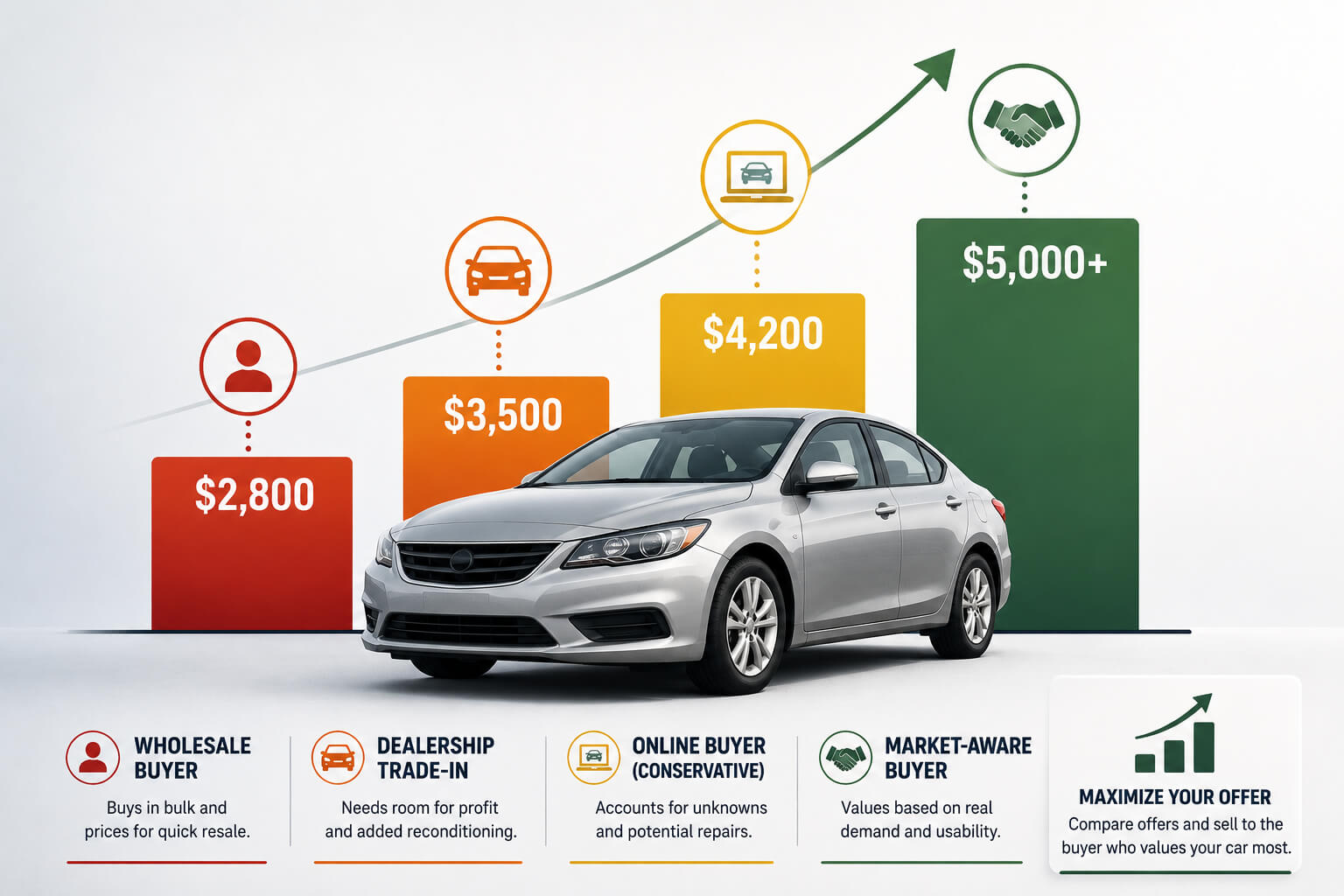
This is why one buyer might offer $3,000 while another comes in at $4,500 or more.
The car hasn’t changed. The lens being used to evaluate it has.
Once you understand that, the goal becomes clear. You’re not trying to “guess the right price.” You’re trying to find the buyer who values your car the most.
The Buyer Matters More Than the Car
Most sellers spend time thinking about how to improve the car.
In reality, the bigger lever is who you sell it to.
Some buyers:
- apply strict mileage limits
- heavily discount for minor issues
- avoid certain vehicles entirely
Others:
- look at real usability
- understand repair costs more accurately
- are comfortable working with higher mileage or imperfect cars
That difference alone can create a gap of hundreds or even thousands of dollars.
The highest offer almost always comes from the buyer who sees the car in the most complete way, not the most conservative one.
Why Fixing Everything Doesn’t Always Help
It’s tempting to think that putting money into the car will automatically increase its value.
Sometimes it helps. Often it doesn’t.
Buyers don’t reimburse you for what you’ve spent. They look at what the car is worth right now. If a repair costs $1,000, it doesn’t mean the value increases by $1,000.
In many cases, especially with higher mileage vehicles, the increase is much smaller.
That’s why the goal isn’t to make the car perfect. It’s to remove doubt where it matters and avoid spending money where it doesn’t change the outcome.
Condition Still Matters — But Clarity Matters More
Buyers expect used cars to have some level of wear.
Scratches, minor damage, and small issues are normal. What slows things down is not the condition itself, but the uncertainty around it.
If a buyer isn’t sure what they’re dealing with, they assume the worst. That leads to lower offers or no offer at all.
The strongest offers usually come when the car is easy to understand. When the condition is clear, and the expectations match what the buyer sees, pricing becomes more confident.
Pricing Sets the Tone Immediately
Price doesn’t just attract buyers. It shapes how they think about the car.
If the price feels off compared to similar vehicles, buyers hesitate. If it feels too low, they start wondering what’s wrong. If it’s too high, they don’t engage at all.
The right price does something different. It signals that the car fits the market.
That’s when buyers lean in instead of pulling back.
Getting the highest offer isn’t about setting the highest price. It’s about positioning the car where it makes sense, so the right buyers engage.
Why Comparing Offers Is Where the Real Value Is Found
This is where everything comes together.
If you only get one offer, you’re relying entirely on how that one buyer evaluates your car. You’re seeing one version of its value.
The moment you compare offers, the picture changes.
You start to see:
- how different buyers think
- who is pricing conservatively
- who is valuing the car more accurately
That’s where the higher number usually shows up.
Not because the car changed, but because you found a buyer who sees it differently.
Speed vs Price Is Always a Trade-Off
Selling quickly and getting the highest offer don’t always line up perfectly.
The fastest option is usually the most convenient, but it can come with more conservative pricing. Taking a bit more time to compare or find the right buyer often leads to a better result.
That doesn’t mean dragging the process out. It means being intentional.
A small amount of extra effort at the right stage can make a noticeable difference in the final number.
Why Some Cars Consistently Get Stronger Offers
Certain vehicles naturally perform better.
Not because they’re perfect, but because they fit what buyers are already looking for. Practical cars, common models, and vehicles that still serve a clear purpose tend to attract stronger interest.
Even at higher mileage, these cars continue to move because the demand is there.
When a car fits demand, buyers compete more. When buyers compete more, offers improve.
The Goal Isn’t Perfection — It’s Positioning
The biggest shift is understanding that you’re not trying to build the perfect car.
You’re trying to position it correctly.
That means:
- understanding where it fits
- knowing what buyers care about
- making it easy to evaluate
Once that happens, the process becomes much more predictable.
Get a Real Offer, Then Improve Your Position
If you want to get the highest offer, the best starting point is to see how your car is being evaluated right now.
A real offer gives you a baseline. From there, you can decide whether to adjust anything, compare further, or move forward.
VendaCar provides instant offers based on condition, demand, and usability, giving you a clear benchmark before you make any decisions.
That’s where you start to see the difference between an average offer and a strong one.