
Quick Answers
Here are the essential documents you need to sell your car in Ontario:
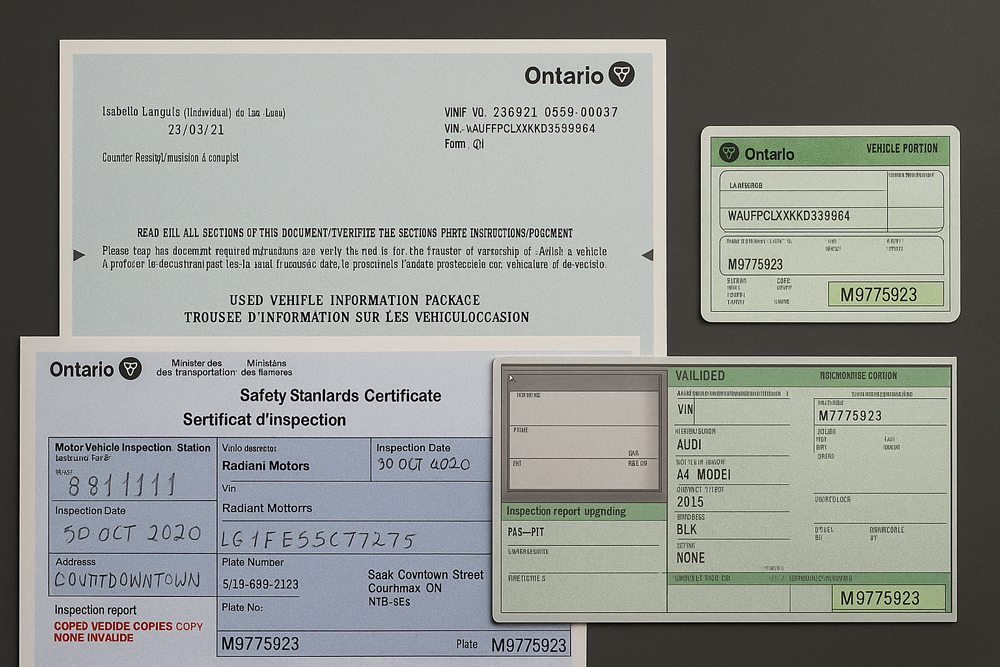
1. Vehicle Ownership Permit (Green Ownership Paper)
You must sign the back portion (Vehicle Portion) to transfer ownership.
2. Used Vehicle Information Package (UVIP)
Legally required for private sales. Includes lien info, accident history, and previous owners.
3. Bill of Sale
A simple written document showing buyer/seller details, VIN, price, and date.
4. Safety Standards Certificate (SSC)
Not required to sell, but the buyer needs one to register and plate the vehicle.
5. Emissions Test
No longer required for most cars in Ontario (light-duty vehicles 7 years or newer are exempt).
6. Loan Payout or Lien Release Letter
Required if the car has an active lien or outstanding loan.
7. Service Records / Maintenance History
Optional, but increases trust and improves your offer.
Now let’s go deeper and explain each one in detail.
The Complete Guide to Ontario Car-Sale Paperwork
Selling your car in Ontario — whether privately or online — means handling a few specific documents. The rules aren’t complicated, but missing even one step can delay a sale or cause issues with the buyer.
This guide explains every document you need, why it matters, how to get it, and how the entire transfer process works in 2025.
1. Vehicle Ownership Permit (Green Ownership Paper)
This is the official document that proves you legally own the car. It has two parts:
- Vehicle Portion — stays with the car and must be signed when you sell it.
- Plate Portion — stays with you if you’re keeping your licence plates.
Where to find it:
Usually in your glovebox or with your important paperwork.
What you must do:
- Fill out the section called “Application for Transfer” on the back.
- Include the buyer’s name, date of sale, and your signature.
Important:
In Ontario, licence plates stay with the seller, not the car. Remove your plates after the sale.
2. Used Vehicle Information Package (UVIP)
This is legally required for all private sales in Ontario.
What the UVIP includes:
- Vehicle details (make, model, year, VIN)
- Previous owners
- Odometer records
- Lien information
- Average wholesale value (from the Canadian Red Book)
- Instructions for completing the sale
How to get it:
You must order it from ServiceOntario:
- Online through the ServiceOntario website
- Or purchase in person
Cost: ~$20
Why buyers want it:
It proves the vehicle is legitimate, not stolen, and does not have hidden liens or ownership problems.
3. Bill of Sale
Ontario law requires a Bill of Sale for every vehicle transfer.
It can be handwritten or typed — there is no official template.
The Bill of Sale must include:
- Buyer’s full name and address
- Seller’s full name and address
- Vehicle Identification Number (VIN)
- Make, model, year
- Purchase price
- Date of sale
- Signatures of buyer and seller
Tip:
Include the odometer reading for extra protection for both parties.
Common mistake:
Writing “gift” to avoid taxes — this only applies for transfers between family members listed by the province.
4. Safety Standards Certificate (SSC)
A Safety Standards Certificate confirms the vehicle meets minimum safety standards in Ontario.
Do you need it to sell the car?
No.
You can legally sell a car without a safety certificate.
Does the buyer need it?
Yes.
The buyer must get (or receive) a safety certificate to register the car and put plates on it.
When should you provide one?
Providing a recent safety certificate can:
- Increase the selling price
- Speed up the transaction
- Show transparency and build trust
Where to get it:
Any licensed Motor Vehicle Inspection Station (MVIS).
Cost:
Typically $100–$150 plus repair costs (if needed).
5. Emissions Testing
Ontario eliminated Drive Clean testing for most light-duty vehicles.
Who still needs an emissions test?
- Heavy-duty diesel vehicles
- Some commercial vehicles
- Older diesel trucks
Most regular cars no longer need emissions testing to be sold or transferred.
6. Loan Payout Statement or Lien Release Letter
If there is a lien on the vehicle, you must disclose it — the UVIP will show it automatically.
What counts as a lien?
- Bank financing
- Car loans
- Leasing companies
- Unpaid repair/shop liens
To sell a car with a lien:
You need:
- A payout statement showing the remaining balance
- A lien release letter once the loan is paid
VendaCar can help sellers with vehicle loans by:
- Paying off the lien directly
- Sending you the remaining balance
- Handling the paperwork
This makes the process much easier if the car is financed.
7. Service Records and Maintenance History
Not legally required, but recommended.
Buyers and online evaluators look favourably on cars with documented maintenance, such as:
- Oil changes
- Tire rotations
- Brake service
- Warranty work
- Repairs
Good records can help you get a higher offer because they prove the vehicle was properly cared for.
Step-By-Step: How the Entire Paperwork Process Works
Here’s the full flow of a private sale or online sale in Ontario:
Step 1 — Seller prepares documents:
- Ownership permit
- UVIP
- Bill of Sale
- Optional safety certificate
- Optional service records
Step 2 — Vehicle is sold:
- Plates stay with the seller
- Seller removes insurance after closing
- Buyer receives signed ownership + bill of sale
Step 3 — Buyer registers the vehicle:
Buyer goes to ServiceOntario with:
- Signed ownership
- Bill of sale
- UVIP
- Safety certificate
- Insurance
- Personal ID
Step 4 — Taxes are paid:
The buyer pays HST based on the greater of:
- The purchase price
- The average wholesale value listed in the UVIP
(Ontario uses whichever number is higher.)
How VendaCar Simplifies the Paperwork
Selling privately means handling every step alone.
Selling with VendaCar means the paperwork becomes simple and guided.
VendaCar helps with:
- Confirming ownership and identity
- Reviewing or assisting with lien payouts
- Preparing the Bill of Sale
- Completing transfer requirements correctly
- Ensuring secure payment at pick-up
- Handling all inspection paperwork on our side
You get a clear process, a fair offer, and support throughout the transfer.