
Key Takeaway
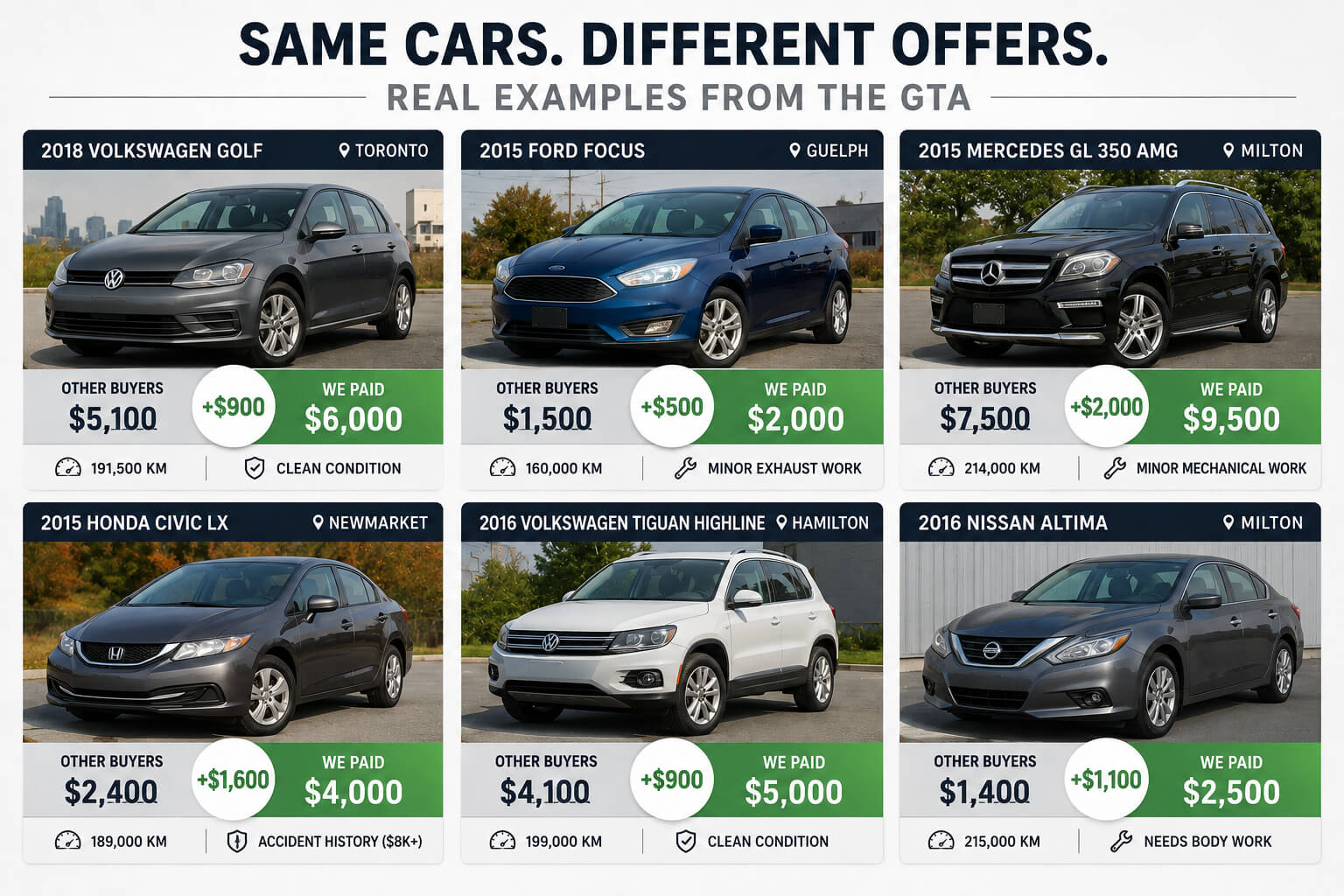
The same car can receive offers that differ by hundreds or even thousands of dollars. The difference isn’t the vehicle. It’s how each buyer evaluates it, what risks they’re willing to take, and how they plan to resell it.
Why Car Offers Vary More Than People Expect
Most sellers assume their car has a fairly fixed value.
They check a few listings, maybe get a quote or two, and expect the numbers to land in a similar range. When one offer comes in significantly lower or higher than another, it feels confusing.
But once you look at real examples, the pattern becomes clear.
Cars aren’t priced based on one universal standard. They’re priced based on how each buyer sees them.
Some buyers are conservative. Others are flexible. Some avoid risk entirely, while others build their business around it.
That’s where the gap comes from.
Real GTA Examples: Same Cars, Different Offers
Here’s how that plays out in the real market.
2018 Volkswagen Golf — $900 Higher Offer
This 2018 Volkswagen Golf Trendline came in from Toronto with 191,500 kilometres and was in clean overall condition, with only regular wear and tear.
At this mileage level, many buyers start to apply stricter rules. Even when the car is well maintained, the kilometres alone can push offers down.
Despite that, vehicles like the Golf continue to perform well because they’re widely driven, reliable, and still in demand.
In this case, the difference came down to how mileage was interpreted. Some buyers focused heavily on the number, while others looked at the full picture, including condition and market demand.
That shift in perspective resulted in a $900 higher offer.
2015 Ford Focus — $500 Higher Offer
This 2015 Ford Focus came out of Guelph with 160,000 kilometres. The vehicle was clean overall but had some rusting and required minor exhaust work.
For many buyers, any visible issue becomes a reason to discount heavily. Even small repairs can trigger larger deductions when the buyer is unsure of the true cost or risk.
In this case, the difference came down to how those repairs were evaluated.
Some buyers priced it as a problem vehicle. Others saw it as something manageable, with straightforward work needed.
That difference resulted in a $500 gap between offers.
2015 Mercedes GL 350 AMG — $2,000 Higher Offer
This 7-seater luxury SUV came from Milton with 214,000 kilometres. It had average cosmetic wear and required some minor mechanical work.
Luxury vehicles at higher mileage often get hit harder in pricing. Many buyers avoid them altogether because of perceived maintenance costs and resale uncertainty.
But there is still demand for these vehicles, especially when they remain functional and practical.
In this case, some buyers stepped back because of the kilometres and category. Others recognized that there is still a market for high mileage luxury SUVs.
That difference resulted in a $2,000 spread in offers.
2015 Honda Civic LX — $1,600 Higher Offer
This Civic came in from Newmarket with 189,000 kilometres and an accident history over $8,000, along with some minor rust and visible wear.
Accident history tends to narrow the buyer pool quickly. Many buyers either avoid these vehicles or price them very conservatively.
However, cars like the Civic still hold strong demand, even with history, as long as they remain usable and reasonably maintained.
In this case, the difference came from how much weight was placed on the accident versus the overall usability of the car.
That resulted in a $1,600 difference between offers.
2016 Volkswagen Tiguan Highline — $900 Higher Offer
This Tiguan came out of Hamilton with just under 200,000 kilometres and was in clean condition with only minor wear.
SUVs like the Tiguan continue to perform well because they fit a wide range of buyers looking for space and practicality.
Even at higher mileage, the demand remains steady.
Some buyers still apply strict mileage-based pricing. Others focus more on how the vehicle fits into the current market.
That difference created a $900 gap in offers.
2016 Nissan Altima — $1,100 Higher Offer
This Altima came from Milton with 215,000 kilometres and required body work to bring it into certifiable condition.
For many buyers, once a car needs visible work, the pricing becomes more aggressive. It’s not just about the repair cost. It’s about the uncertainty.
Other buyers, however, are comfortable taking on vehicles as-is, especially when the repairs are manageable.
In this case, the difference was how much weight was placed on the required work versus the overall usability of the car.
That resulted in a $1,100 higher offer.
What These Examples Actually Show
When you look at these side by side, a pattern starts to emerge.
The cars are different, but the reason behind the price gap is the same.
It comes down to:
- how mileage is interpreted
- how repairs are estimated
- how much risk the buyer is willing to take
- how well the car fits current demand
Some buyers rely on strict rules. Once a car crosses a certain threshold, whether it’s kilometres, condition, or history, the pricing drops quickly.
Other buyers take a more flexible approach. They evaluate the full picture and focus on how the car can still be used and resold.
That difference is what creates the gap.
Why This Matters When You’re Selling
If you only get one offer, you’re seeing one version of your car’s value.
That number might be conservative. It might reflect a buyer who avoids risk or works within strict limits.
But that doesn’t mean it’s the highest value your car can achieve.
Once you start comparing offers, you see how different buyers approach the same vehicle. That’s when the real value becomes clear.
It’s Not About the Car — It’s About the Buyer
This is the biggest shift.
The value of your car isn’t fixed. It depends on who is evaluating it.
One buyer sees risk and lowers their offer. Another sees opportunity and prices it differently.
The car hasn’t changed, but the outcome has.
See What Your Car Is Actually Worth
The easiest way to understand your car’s value is to compare how different buyers price it.
VendaCar provides instant offers based on real market demand, condition, and usability, giving you a clear benchmark before making any decisions.
From there, the difference between an average offer and a strong one becomes much easier to see.