
Key Takeaway
Car buyers don’t all evaluate vehicles the same way. Some rely on strict pricing rules and higher margins, while others assess real demand, usability, and condition more flexibly. That difference in approach is what leads to significantly higher offers for the exact same car.
Why the Same Car Can Get Very Different Offers
One of the most confusing parts of selling a car is seeing how much offers can vary.
It’s not uncommon for the same vehicle to receive multiple offers that are hundreds or even thousands of dollars apart. For most sellers, this feels random. The assumption is that there must be a “right” number and that anything lower is simply a bad offer.
In reality, those differences are not random at all.
They come down to how each buyer evaluates risk, demand, and resale potential. The car itself has not changed. The approach behind the offer has.
Understanding that difference is what allows you to avoid leaving money on the table.
Not All Car Buyers Are Built the Same
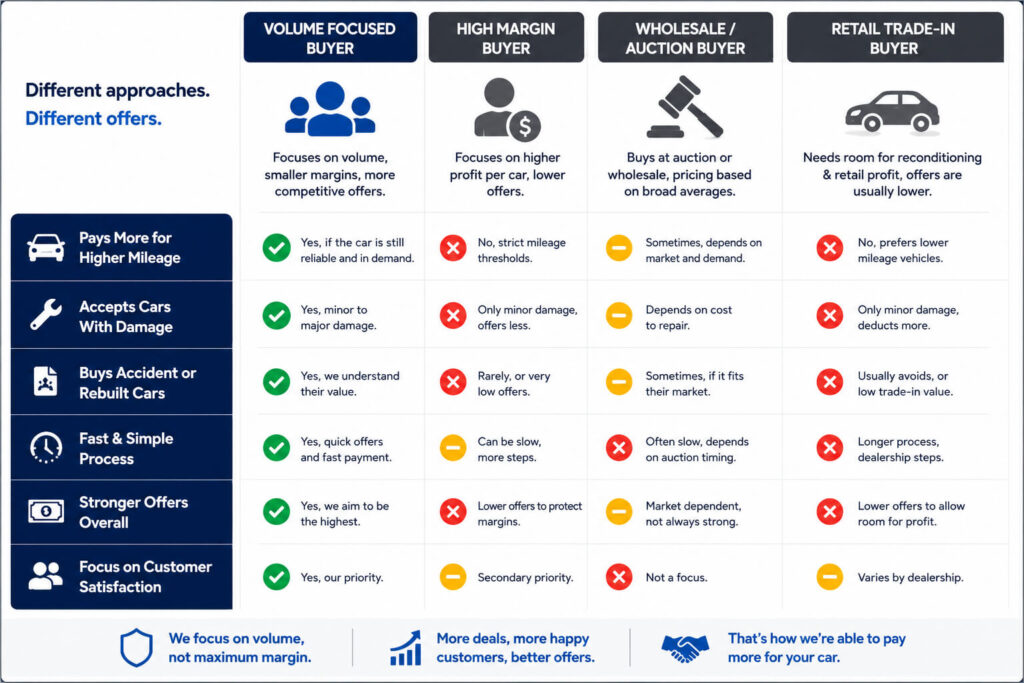
At a high level, most car buyers fall into a few different categories. Each one has a different goal, and that goal directly affects how they price vehicles.
Some buyers prioritize simplicity and speed but protect themselves with conservative pricing. Others are focused on maximizing margin on each individual vehicle. Then there are buyers who operate on volume and are willing to accept tighter margins in exchange for more deals.
These differences may not be obvious from the outside, but they have a major impact on the final offer you receive.
The Role of Risk in Pricing
Every buyer is managing risk.
When someone purchases a used vehicle, they are taking on uncertainty. That includes potential repairs, resale challenges, and market fluctuations. The way a buyer handles that risk determines how aggressive or conservative their offer will be.
Some buyers reduce risk by lowering their offer significantly. This gives them more room to handle anything unexpected, but it also leads to weaker pricing for the seller.
Others take a more balanced approach. They evaluate the car more carefully and adjust based on actual condition and demand rather than applying blanket reductions.
This is often where the gap in pricing begins.
Mileage Thresholds vs Real Evaluation
One of the most common differences between buyers is how they treat mileage.
Many buyers rely on strict thresholds. Once a car crosses a certain point, such as 150,000 km or 200,000 km, the pricing drops quickly. This happens regardless of how the car actually looks or performs.
This approach is simple, but it is not always accurate.
Other buyers look beyond the number itself. They consider:
- how the car has been maintained
- whether it is still usable and reliable
- how it fits into current market demand
This creates a more flexible evaluation and often leads to stronger offers, especially for vehicles that are still practical despite higher kilometres.
Condition Is Interpreted Differently
Two buyers can look at the same vehicle and come to very different conclusions.
For example, a car with minor body damage, warning lights, or small repairs needed may be heavily discounted by one buyer, while another sees it as a manageable cost.
The difference is not the condition itself. It is how that condition is interpreted.
Buyers who overestimate repair costs or assume worst-case scenarios will lower their offers more aggressively. Buyers who understand the actual cost and impact of those issues are able to price more accurately.
That difference often results in a noticeable gap in offers.
Some Buyers Avoid Entire Categories of Cars
Another major factor is what a buyer is willing to accept in the first place.
Many buyers avoid:
- rebuilt or salvage title vehicles
- cars with accident history
- vehicles with higher mileage
- cars that need repairs
This is not because those cars have no value. It is because they fall outside of that buyer’s model.
When a buyer avoids a category entirely, it reduces competition. With fewer buyers willing to make an offer, pricing naturally drops.
Buyers who are able to work within those categories often provide stronger offers simply because they are willing to participate where others are not.
Demand Plays a Bigger Role Than People Expect
Not all vehicles are equal in the market.
Some cars continue to perform well regardless of mileage or condition because they match what buyers are actively looking for. Practical sedans, compact SUVs, and work-ready trucks often fall into this category.
When a buyer understands that demand, they can price the vehicle more confidently.
Other buyers rely on general rules that do not fully account for demand. This can lead to underpricing vehicles that still have strong market appeal.
The more accurately demand is understood, the more accurate the offer becomes.
Margin Strategy Is One of the Biggest Differences
This is one of the most important but least understood factors.
Some buyers operate on higher margins. They need to build in more profit on each vehicle, which means their offers are lower from the start. This approach works for their model, but it limits how competitive they can be.
Other buyers focus on volume. Instead of making as much as possible on each individual car, they aim to complete more deals overall.
This allows them to:
- accept tighter margins
- stay competitive across more vehicles
- provide stronger offers consistently
For sellers, this difference is significant. It often explains why one buyer is noticeably higher than another, even when everything else seems similar.
Why the Process Itself Affects the Offer
How a buyer operates also influences pricing.
Buyers with slower or more complex processes may need to protect themselves with more conservative offers. They are accounting for time, uncertainty, and additional steps.
Buyers with streamlined processes can move faster and evaluate more efficiently. This reduces overhead and allows for more flexibility in pricing.
The result is not just a faster experience, but often a better offer as well.
Real-World Examples Show the Pattern Clearly
Looking at actual deals makes these differences easier to understand.
A clean SUV with higher mileage may receive a conservative offer from one buyer due to kilometre thresholds, while another buyer sees strong demand and prices it higher.
A rebuilt vehicle may receive no offer at all from certain platforms, while another buyer evaluates its usability and makes a competitive offer.
A car with minor damage may be heavily discounted by one buyer but treated as a manageable repair by another.
In each case, the car is the same. The outcome changes based on how it is evaluated.
Why Sellers Often Accept Lower Offers
Many sellers assume that all buyers think the same way.
Because of that, they may accept the first reasonable offer they receive without realizing that other buyers would have evaluated the car differently.
Without comparison, it is difficult to see where your car actually stands.
This is why understanding the differences between buyers is so important. It gives you the ability to recognize when an offer reflects real value and when it is simply conservative pricing.
Getting the Best Outcome Comes Down to Comparison
The easiest way to see these differences is to compare offers.
When you receive more than one offer, patterns begin to appear. You can see which buyers are applying stricter rules and which ones are evaluating the car more fully.
This allows you to make a decision based on real information rather than assumptions.
Why This Matters More Than Ever in the GTA
In a market like the GTA, there are more buyers and more variation than in smaller regions.
This creates both opportunity and confusion.
On one hand, there is a higher chance of finding a buyer who values your car properly. On the other hand, there is a wider range of pricing approaches, which can make it harder to know what your car is actually worth.
Understanding how buyers think is what helps you navigate that complexity.
Understanding the Difference Is What Protects Your Value
Selling a car is not just about finding a buyer. It is about finding the right buyer.
When you understand why offers vary, you are less likely to accept a number that does not reflect your car’s true value.
Instead, you can recognize when a buyer is pricing conservatively and when they are evaluating the car more accurately.
That awareness is what protects your outcome.
Get a Real Offer and See the Difference
If you want to understand how your car is being evaluated, the best place to start is with a real offer.
VendaCar provides an instant offer based on your car’s actual condition and market demand, allowing you to see where you stand without the usual guesswork.
From there, you can compare and decide what makes the most sense for you.